Impacted Canine Exposure in Gaithersburg and Clarksburg, MD
If an orthodontist has told you that your child has an impacted canine and needs a procedure called exposure and bonding, this page is here to explain what that means.
The short version: one of your child’s adult canine teeth has formed properly but is stuck under the gum and will not come down on its own. A minor surgical procedure uncovers it and attaches a small bracket, and braces then guide it into place over the following months. It is common, it is planned rather than urgent, and it is not an extraction. The tooth is being saved, not removed.
Gaithersburg: (301) 216-1780 | Clarksburg: (301) 515-5100
Why This Cannot Wait Indefinitely
Most parents’ first question is whether this procedure is really necessary. It is, and the reason is worth understanding.
Upper canines are the last front teeth to come in, usually around age eleven or twelve, and they have the longest roots of any tooth in the mouth. When one becomes trapped, it does not simply stay put. It continues trying to erupt along whatever path is available, and that path frequently runs directly into the roots of the front teeth beside it.
The result can be root resorption, where the impacted canine gradually wears away the root of a neighboring incisor. That damage is permanent. A tooth that loses enough root structure cannot be saved, and what began as one stuck canine becomes two or three teeth lost.
This is why orthodontists take impacted canines seriously and why the recommendation usually comes with a timeline attached. Treated at the right point, the canine is guided into place and everything is preserved. Left several years, the options narrow considerably.
The other reason for acting is age. Younger patients respond better and faster. A canine guided down at twelve or thirteen typically moves more readily than the same tooth at 19.
Understanding the Exposure and Bonding Procedure
For patients needing canine exposure in Gaithersburg, MD, our board-eligible periodontist, Dr. Andrew Tong, works in direct coordination with your orthodontist. This procedure is not an extraction, and it does not move the tooth immediately. Instead, Dr. Tong gently uncovers a portion of the impacted canine and bonds a miniature bracket to its surface. That bracket connects to a tiny gold chain, which your orthodontist uses to apply gradual traction over time.
The surgical approach depends on the tooth’s depth and your overall treatment plan:
- Open Eruption: The tooth is uncovered and left exposed so it can emerge with guided assistance.
- Closed Eruption: The bracket is bonded and the gum tissue is sutured back, leaving only the chain visible beneath the gumline.
This minor surgical visit is one foundational step in your broader orthodontic plan. Successful treatment relies on precise clinical coordination, and the timing of the procedure, secure bracket placement, and a well-structured traction schedule all matter.
Coordinated Orthodontic and Periodontal Care Under One Roof
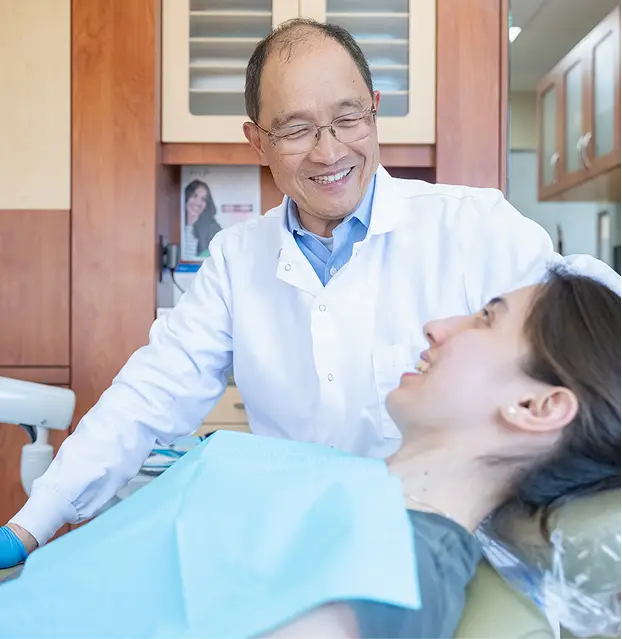
Exposure and bonding is not one procedure by one doctor. It needs a periodontist to surgically uncover the tooth and bond the attachment, and an orthodontist to create the space beforehand and apply the traction afterwards.
At most practices those are two separate offices. The family books with one, waits, books with the other, and carries records between them. When the two do not coordinate closely, treatment stalls.
Both specialists are here.
- Dr. Andrew Tong is a board-certified periodontist and performs the surgical exposure.
- Dr. James Tong is an orthodontist and a Clinical Assistant Professor at the University of Maryland School of Dentistry.
They work in the same practice, review the same digital imaging, and schedule the surgery around the orthodontic timeline rather than around whichever appointment happened to be available. For you, that means one practice to call and no records to ferry.
If your child is already with an outside orthodontist, that is completely fine and very common. Dr. Andrew Tong performs exposures for patients of other practices regularly. We coordinate directly with your orthodontist on timing, bracket placement, and the traction plan, and your child continues their braces where they are.
What to Expect: Your Procedure and Recovery
The procedure takes about 45 to 60 minutes.
Your child receives local anesthetic so the area is fully numb. Dr. Andrew Tong then lifts a small amount of gum tissue to reach the impacted canine, bonds a tiny bracket to its surface, and attaches a fine gold chain to that bracket. The chain is what the orthodontist will later use to apply gentle pressure.
There are two approaches, and which one is used depends on how deeply the tooth sits:
- Open exposure. The tooth is uncovered and left visible, allowing it to erupt with guidance.
- Closed exposure. The bracket is bonded and the gum is stitched back over it, with only the chain visible at the gumline.
Dr. Tong will explain which approach your child’s case calls for, and why, before the day of surgery.
If your child is anxious, tell us when you book. Sedation is available, including nitrous oxide, which wears off before they leave. Anxiety about a surgical appointment at this age is entirely normal and worth planning around rather than pushing through.
Recovery
Most children are back at school within a day or two.
Expect mild soreness and some swelling for the first three to five days, manageable with over-the-counter pain relief. Soft foods for the first few days, gentle brushing away from the surgical site, and warm salt water rinses to keep the area clean.
The chain may look alarming when you first see it. It is meant to be there, and it will gradually disappear from view as the tooth moves into position.
One thing to watch for: if the bracket or chain comes loose, call us the same day. It is a straightforward repair, but a loose attachment stops the traction, and that delay adds directly to your child’s total time in braces.
Questions Parents Ask about Canine Exposure
Will my child be in a lot of pain?
The procedure itself is done under local anaesthetic, so there should be no pain during it. Afterwards, expect soreness and swelling for a few days, generally well managed with over-the-counter pain relief. Most children describe it as uncomfortable rather than painful.
How long does it take to bring an impacted canine into place after exposure and bonding?
Guiding an impacted canine into position typically takes several months to a year. The timeline depends on the tooth’s initial depth, the patient’s age, and how much space is available in the dental arch. Your orthodontist manages this gradual movement using precise, gentle traction applied through the bonded bracket.
Is impacted canine exposure covered by dental or medical insurance in Maryland?
Coverage depends on your specific insurance policy and the underlying diagnosis. Most plans categorize this procedure under dental benefits, though certain complex structural cases in Maryland may involve medical insurance coordination. Our administrative team helps you verify your benefits and files all necessary claims to maximize your available coverage.
How long will the whole process take?
Bringing the canine into position generally takes somewhere between several months and a year after the surgery.
The variables are how deeply the tooth was impacted to begin with, your child’s age, and how much space is available in the arch. Deeper impactions take longer. Younger patients move faster.
The orthodontic work carries on around it. The exposure is a single appointment within a longer treatment plan rather than a separate course of treatment.
What if the chain or bracket comes loose?
Contact our office immediately rather than attempting any adjustment yourself. Prompt clinical attention is critical — delays can disrupt your active orthodontic traction schedule and prolong total treatment time. Our team will bring you in quickly to secure the attachment and keep your alignment plan on track.
Can early orthodontic treatment prevent canine impaction?
Early evaluations around age seven cannot guarantee prevention, but they significantly reduce the risk. By managing jaw space and monitoring development, our team can often guide erupting teeth naturally before a surgical intervention becomes necessary.
Begin your tong care journey
Schedule Your Canine Exposure Evaluation
Canine exposure requires a surgical and orthodontic team that communicates closely at every stage. Our practice offers that coordination under one roof, with an in-house periodontist and orthodontic expertise that removes the delays of external referrals. Saturday appointments are available.